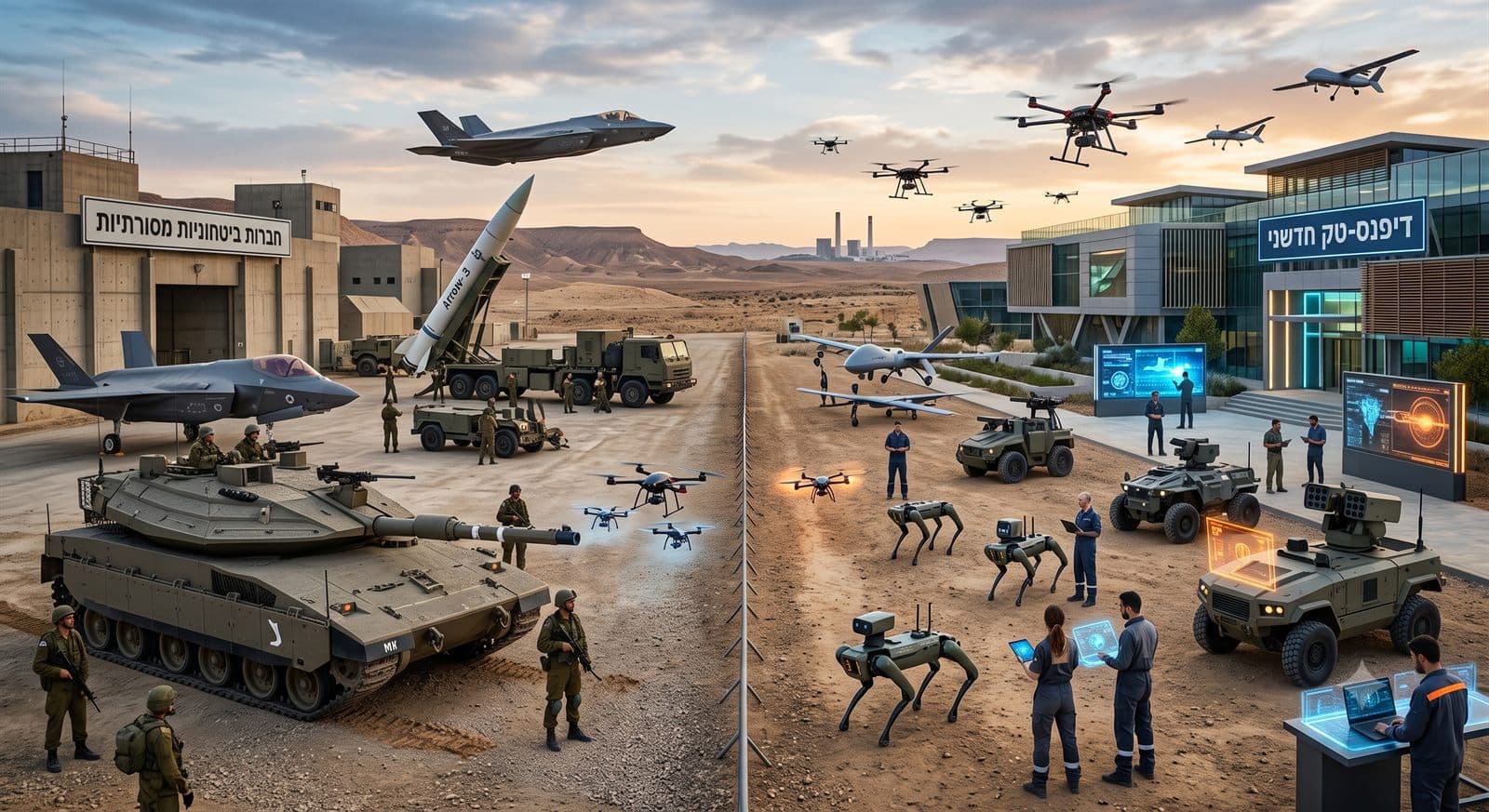
While the markets are busy with the question of whether the AI revolution will justify the valuation, another sector is building quiet but consistent momentum: the defense industry. The latest trigger came today from a familiar direction - Elbit Systems - but to understand it correctly you have to raise your gaze above the single contract, to the broad picture of what has been driving defense stocks in recent years, and where the fault line runs between the old players and the new challengers.
The Trigger: Elbit Crosses the Border (Literally)
This morning (7/20), Elbit Systems reported that its U.S. subsidiary, Elbit Systems of America, won a series of contracts from U.S. Customs and Border Protection (CBP) worth a total of over $370 million. Work under the contracts is expected to be completed by May 2029. The stock responded with a gain, and the market took the win as further confirmation of the depth of Elbit's foothold in the U.S. market - one of its central targets.
An important precision: Elbit did not detail which specific systems are included in the contract. Per its announcement, these are technologies meant to improve real-time situational intelligence and support CBP operations. The company's CEO and chairman, Bezhalel (Butzi) Machlis, noted that the wins illustrate Elbit America's ongoing contribution to strengthening U.S. security, and highlight the ability to provide "reliable real-time situational intelligence." In that context, it is worth recalling that Elbit previously supplied CBP with autonomous surveillance towers along the southern border - so the logic of monitoring and control systems fits its profile, even if the details of the current contract were not disclosed.
Beyond the win itself, there is something representative here. Elbit is a clear example of a company that built itself a local presence in the world's largest defense market and wins long-term government contracts there. And that is exactly the kind of revenue driving the whole sector right now.
The Big Picture: A Supercycle, Not a One-Off Event
Elbit's win does not take place in a vacuum. The world is in the midst of a broad-based defense rearmament wave, against a backdrop of geopolitical tension, active wars and pressure on European countries to increase their defense budgets. The question that interests investors is not whether spending will grow, but where the money will flow - and who will capture it.
Here an interesting figure enters. Per research by BCG and Vertical Research Partners (as reported), precisely in an era of drones and autonomous weapons, complex systems (fighter jets, air-defense systems, ships) are expected to continue to constitute over 80% of defense spending through 2033. In numbers: spending on complex systems is expected to grow from about $65 billion to about $79 billion, while the "cheap and mass" weapons categories are expected to grow faster in percentage terms - but from a far lower base. In parallel, the European defense-equipment market alone is expected, per the same research, to jump from about 150 billion euros in 2024 to about 380 billion euros in 2035.
Why do the old giants keep capturing the lion's share? The answer lies in the business model. Selling a platform - an aircraft, a ship, an interception system - is only the start of the story. After it come decades of revenue from maintenance, spare parts, software upgrades, training and support. This is a recurring-revenue moat that is very hard to breach, and it is what gives companies like Lockheed Martin, RTX and Boeing - and Elbit, at its scale - cash-flow stability over time.
But Beneath the Surface: The Defense-Tech Wave
That does not mean the picture is static. Alongside the traditional systems, a wave of defense-tech is growing that tries to change the rules of the game - and every investor in the sector should keep an eye on it.
The trends identified in defense coverage (including in Defense News TechWatch) paint a clear direction: a move to autonomy and to quantity. The U.S. Navy is ordering unmanned vessels; Saronic, a maker of autonomous ships, was selected to build a shipyard worth about $3 billion; the Air Force is moving to cheaper cruise missiles that can be bought in quantity; and the Pentagon is examining cheap alternatives to the MQ-9 drone. In the background, laser technologies, attack drones and new air-defense systems are also developing. On the capital front, startups like Helsing and Quantum Systems raised enormous sums - evidence that private capital is betting on the new players.
But here hides a nuance the investor must know: the big defense-tech story did not always translate into returns in the pure "drone" stocks. Precisely in 2026, many of them suffered negative sentiment and sharp volatility - from AeroVironment (AVAV), which lost a contract and wrote off about $1.7 billion from its long-term forecast, through Kratos (KTOS), which suffers from a combination of high valuation and "lumpiness" in the timing of budget approvals, to the small and volatile names like Ondas (ONDS), Unusual Machines (UMAC) and Red Cat (RCAT). The picture is not uniform - some of the stocks even recovered - but the message is consistent: investing in the "disruptors" is a far more volatile path than investing in the "veterans." And especially interesting: despite the weakness in the stocks, sector order backlogs actually swelled, and the Pentagon's 2027 budget request includes, per reports, about $75 billion for unmanned systems and counter-drone warfare. In other words, a gap opened between market sentiment and demand on the ground - and such a gap is exactly where a patient investor looks for opportunity, alongside the risk.
And this is exactly the debate. The "bull" side of defense-tech argues that the future belongs to whoever produces mass quantities of cheap, autonomous systems, and that it will hurt the profitability of the expensive platforms. The "bear" side of that same thesis argues that the giants will simply absorb these technologies themselves - by acquisition or development - and keep their dominance, exactly as BCG's research estimates. The truth, as always, is probably somewhere in the middle: not a revolution that erases the old, but an evolution in which whoever succeeds in connecting the platform to the autonomous system will win.
The Israeli Angle and the Investment Lens
Israel is one of the significant players in the world in this field, but for the investor on the local exchange the map is narrower than it seems. The two large giants
- Israel Aerospace Industries (IAI) and Rafael - are state-owned companies that do not trade as stocks. Therefore Elbit (ESLT), which trades both in Tel Aviv and on the Nasdaq, is the central defense pure-play in Israel.
Alongside it there are smaller, more focused companies riding the wave - for example Nextvision (NXSN), which develops stabilized imaging systems for drones and unmanned aircraft, and Aryt Industries (ARYT), whose subsidiary Reshef Technologies makes electronic fuzes and has benefited from surging munitions demand. These illustrate the potential - and the volatility - of the small players in the sector.
On the global stage, the sector's "default" remains the trio of American giants, which embody the recurring-revenue model at its best:
What to remember before running in
A sector with a strong tailwind still does not turn every stock into a good investment. A not-small part of the defense outlook is already priced in after a sharp run, and the tension between the "giants" and "defense-tech" is a real risk, not just a story. The usual questions remain: valuation, order backlog, profit margins, exposure to currency and to government budgets that could change. The sector shows where there is a tailwind; picking the company remains the investor's work.
The Bottom Line
Elbit's $370 million win is a good headline, but the real story is bigger than it: we are inside a multi-year defense rearmament cycle, fueled by geopolitical tension and by the need of entire nations to renew and expand their capabilities. Within this cycle a fascinating struggle plays out between the old and the new - between the platform that generates decades of recurring revenue, and the cheap autonomous machine trying to change the equation.
I am in no rush to decide who will win, because the answer is probably "both, in shifting proportions." What I do take from this week is a reminder: the news headline (an Elbit contract) is only the tip of a deeper trend. Whoever looks only at the single win misses the picture; whoever understands the cycle behind it knows where to start looking.
Sources: Elbit Systems' announcement and its official filings (MAYA, SEC 6-K, PR Newswire), BCG/Vertical Research research as reported, and Defense News TechWatch - current as of the time of writing. The charts are shown in real time via TradingView.


