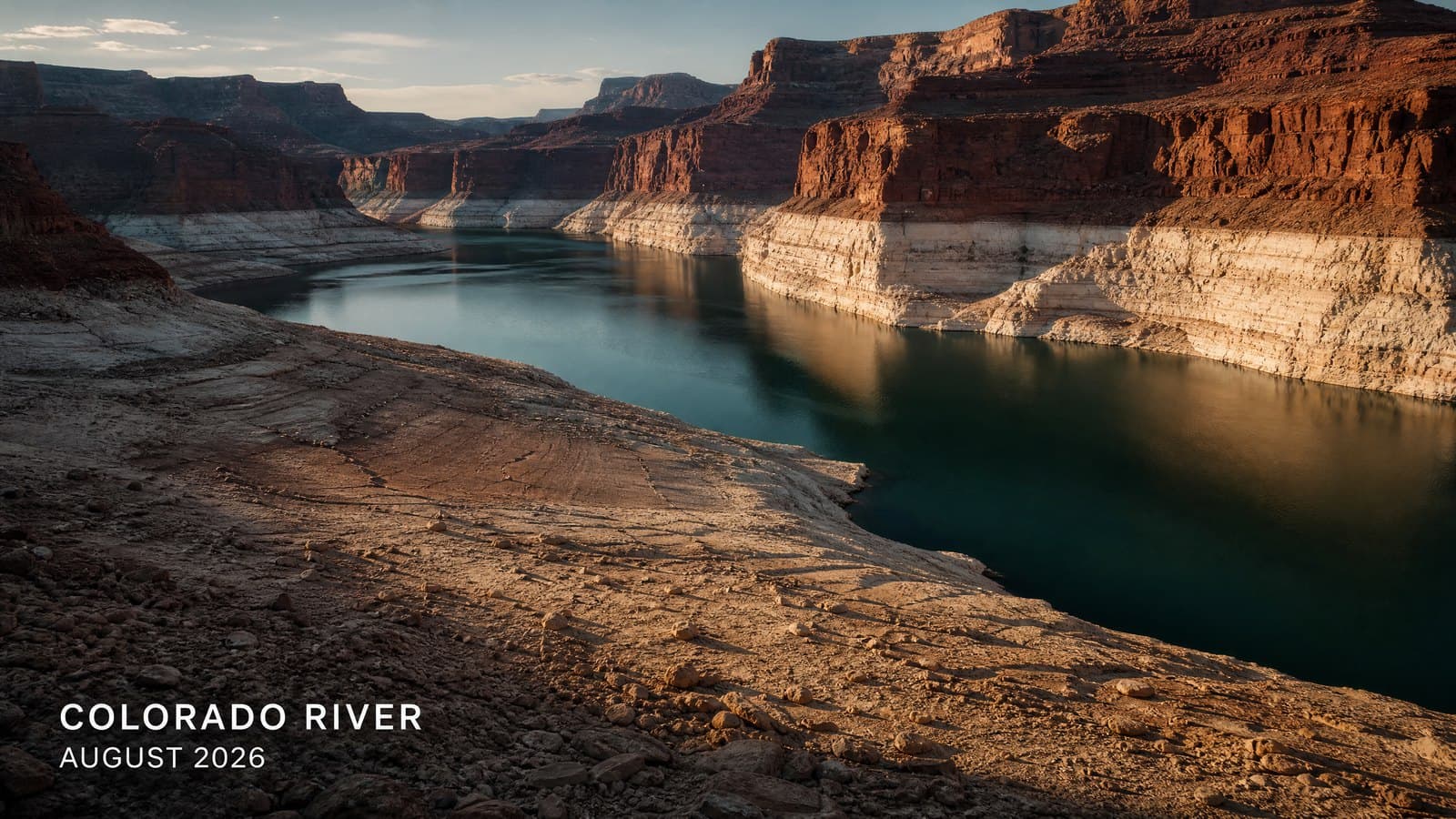
The rules governing the Colorado River - the river supplying seven states and some 40 million people - expire at the end of 2026.
The states failed to agree among themselves. Washington decided for them. And when I checked how an investor is actually exposed to this, I found something I did not expect.
Errors or inaccuracies are possible. Spotted something that looks wrong? Write to me and I will correct it.
Why Now, Specifically
This is not a "water crisis" in the ordinary sense. It is a legal expiry date.
The river is managed under layers of agreements decades old. The operative layer - the one that actually determines how much water is released from Lake Powell and Lake Mead - is the 2007 interim guidelines, alongside the 2019 drought contingency plans and related international agreements.
All of them expire on 31 December 2026.
In other words: this is not a question of whether it rains. It is a question of who holds the authority to allocate water when there is not enough - at a date when the existing answer stops applying.
Which makes it an event you can plan a calendar around, unlike a drought.
The states were meant to agree on replacement rules by 14 February 2026. They did not.
The dispute is simple in essence: the Lower Basin states - Arizona, California and Nevada - demanded that the Upper Basin - Colorado, New Mexico, Utah and Wyoming - also take mandatory cuts in drought years. The Upper Basin refused, arguing it already consumes less than its allocation and that the cuts should come from the Lower.
And What Washington Decided on 31 July
**On 31 July 2026 the federal water agency published its final document for post-2026 reservoir operations
- an adaptive framework for the decade from 2027 to 2036, effective 1 January 2027 and reviewed every two years.**
This is the allocation, and it is worth looking at closely:
| State | Annual mandatory cut | Basin |
|---|---|---|
| Arizona | 760,000 acre-feet | Lower |
| California | 440,000 | Lower |
| Nevada | 50,000 | Lower |
| Total | 1.25 million acre-feet | |
| Colorado | Zero | Upper |
| New Mexico | Zero | Upper |
| Utah | Zero | Upper |
| Wyoming | Zero | Upper |
The document imposes no mandatory cuts on the Upper Basin states.
Which means the state whose name is on the river - Colorado - is among those not required to cut anything. And Arizona absorbs 61% of the entire cut.
That is the answer to "what is happening in Colorado": Colorado held its position, and the federal government did not force otherwise.
And the new framework rests on two elevations as trigger mechanisms:
| The threshold | |
|---|---|
| Lake Powell | Below 3,500 feet protective measures apply |
| Lake Mead | Below 1,000 feet |
| Annual release from Powell, expected range | 5.0 to 12.0 million acre-feet |
| For comparison, the historical volume | about 8.23 million |
And that range is the story: a framework allowing releases of between 5 and 12 million acre-feet does not set a number - it sets discretion. Which is what the losing states object to.
The framework also allows the states to replace it by agreement, if they reach one. So the door remains open - and with it the threat of litigation.
And Now the Question Almost Nobody Asks: Where Does the Water Go
This is where the figure that most surprised me sits, and it comes from peer-reviewed research published in Communications Earth & Environment in March 2024 - the first complete accounting of water consumption in the basin.
| The use | Share of water consumed in the basin |
|---|---|
| Irrigated agriculture, total | 52% |
| Of which - irrigation for cattle feed | 32% |
| Of which - alfalfa alone | 26%, over 5 million acre-feet |
| All cities, commerce and industry combined | 18%, about 3.5 million acre-feet |
Read those last two lines again.
Alfalfa - a forage crop fed to cattle - consumes 26% of the Colorado's water. All the cities in the basin, all commerce and all industry combined consume 18%.
One crop drinks more than all urban and industrial activity in the basin, put together.
And in the Upper Basin - the one that was not cut - cattle-feed crops consume 90% of all agricultural water.
And that changes entirely what is being discussed here.
When people say "water crisis" they picture taps running dry in Phoenix and Las Vegas. But 82% of the water does not go to taps - it goes to fields, and overwhelmingly to growing food for animals.
So the water decision in Colorado is, in practice, a decision about agriculture - who keeps irrigating, with what, and at what price. It also explains why it is so political: cutting water cuts rural livelihoods, not urban showers.
And Now the Investment Side, Where the Sharpest Finding Sits
The obvious investment question is "how do I get exposure". I checked the actual holdings of four ETFs, not their names.
PHO - Invesco Water Resources, 43 holdings
| 1 | Roper Technologies | 9.34% |
| 2 | Ecolab | 8.15% |
| 3 | Waters | 7.07% |
| 4 | Ferguson | 6.89% |
| 5 | IDEXX | 6.18% |
| 6 | Veralto | 4.48% |
| 7 | Agilent | 4.27% |
| 8 | American Water Works | 4.12% |
| 9 | Xylem | 3.84% |
The largest holding in an ETF called "Water Resources" is Roper Technologies - a diversified software and industrial company.
The fifth-largest holding, at 6.18%, is IDEXX - a veterinary diagnostics company.
And the first water utility on the list, American Water Works, is eighth at 4.12%.
And this is not an outlier. First Trust's FIW, 38 holdings, looks similar: Waters 5.24%, Agilent 4.98%, Roper 4.60%, American Water 4.06%, Veralto 4.05%, IDEX 4.04%, Mueller Industries 4.00%. More evenly spread, but the same family of companies - laboratory instruments, valves, pumps and industrial distribution.
And the ETF That Is Genuinely Different
Invesco's CGW, 81 holdings, is built quite differently:
| 1 | American Water Works | 8.20% |
| 2 | Xylem | 7.52% |
| 3 | SABESP - the São Paulo water utility | 6.74% |
| 4 | Essential Utilities | 5.80% |
| 5 | United Utilities - UK | 5.78% |
| 6 | Severn Trent - UK | 5.23% |
| 7 | Veralto | 4.76% |
| 8 | Ecolab | 4.17% |
| 9 | Geberit - Switzerland | 3.83% |
Here six of the nine largest holdings are genuine regulated water utilities - in the US, Brazil and the UK. This is an ETF on water services, not on equipment.
And the European Version
It exists, and it is nearly identical:
iShares Global Water UCITS ETF, listed among other places in Germany under IQQQ, 147 holdings, an expense ratio of 0.65% a year.
| 1 | Xylem | 8.00% |
| 2 | American Water Works | 7.96% |
| 3 | SABESP | 6.93% |
| 4 | United Utilities | 5.66% |
| 5 | Essential Utilities | 5.61% |
| 6 | Severn Trent | 5.08% |
And the geographic split, as of 7 June 2026: United States 60.8%, Latin America 10.5%, United Kingdom 9.5%, Europe ex-euro 6.1%, emerging Asia 4.6%, Japan 4.1%.
Note that its holdings are nearly identical to CGW's - and that is no coincidence: both track the same index, S&P Global Water. The difference between them is not the exposure but the wrapper - the listing venue, the currency, and the tax status.
And What Does Not Exist
I looked for an ETF that holds water, reservoirs or water rights. There is none.
Every ETF I checked holds shares in companies that do things with water - makers of pumps, valves, water meters, treatment systems, and regulated supply utilities. None holds the resource itself.
The only instrument tracking an actual water price is not an ETF but a futures contract:
| The name | Futures on the Nasdaq Veles California Water Index |
| The ticker | NQH2O |
| Traded on | CME |
| Since | Late 2020; the index itself began on 31 October 2018 |
| What it tracks | The spot price of water rights in California |
| What is included | The surface water market, and four adjudicated groundwater basins - Central, Chino, Main San Gabriel, and Mojave Alto |
And three things need to be clear here.
First - this is California, not the Colorado basin. The index measures a different market.
Second - a futures contract is not an ETF. It is a leveraged instrument with expiry dates, contract rolls and margin calls, intended for professional users - mainly farmers and water utilities hedging price risk.
And third - the water market is local by nature. Water is not traded globally like oil or gold, because you cannot move it between basins in meaningful quantity. So a "global water price" does not exist, and cannot.
And on XLI - Worth Clarifying
I checked, and XLI has nothing to do with water in any form.
It is the State Street Industrial Select Sector SPDR - an ETF on the industrials sector of the S&P 500, 86 holdings. The largest holdings: Caterpillar 6.74%, GE Aerospace 6.44%, RTX 5.07%, GE Vernova 4.83%, Boeing 3.11%, Union Pacific 3.03%.
Aerospace, defence, heavy machinery and railroads. There is indirect overlap - some industrial equipment makers also sell into the water market - but this is not water exposure in any useful sense.
What I Will Track
| 1 January 2027 | The new framework takes effect |
| Litigation | The Lower Basin absorbed the entire cut; the legal door is open |
| Powell and Mead elevations | 3,500 and 1,000 feet are the thresholds guiding the system |
| Agriculture | 52% of consumption, and where the real decision will fall |
| The biennial review | The framework is reassessed every two years through 2036 |
הזווית שלי
דעה אישית של אילן אברמוב - לא ייעוץ ולא המלצה
I set out to examine a water crisis, and came back with two findings, neither of them about water.
The first: the decision here is not hydrological but political. The Upper Basin refused to cut, the Lower Basin was cut, and the federal government ratified the outcome. Colorado - the state whose name is on the river - came away without a single mandatory cut, and Arizona carries 61% of the burden. One can think what one likes about that, but this was not an outcome determined in a reservoir. It was determined in a room.
And the second, more important for our reader: the gap between an ETF's name and its contents.
Someone who hears "water crisis" and buys PHO thinks they are exposed to water scarcity. In practice they are buying Roper Technologies at 9.34%, and veterinary diagnostics at 6.18%. These are good businesses or less good ones - but they do not appreciate when water does.
And what I try to hold onto when reading a thematic ETF is one rule: the theme is in the name, the exposure is in the holdings, and those are not the same thing. It takes three minutes to open the holdings list - and it is one of the highest-return-on-time checks in investing.
And what makes this case especially sharp is that the thesis itself is correct: water really is becoming scarcer, and the 31 July decision is proof. But the correct thesis and the available instrument do not connect - and anyone who does not check ends up holding an entirely different exposure from the one they intended.
And if there is a real connection here between the crisis and the market, it is not in water rights but in infrastructure. A state forced to save 1.25 million acre-feet a year buys water meters, recycling systems, wastewater treatment and desalination - which is precisely what the companies in these ETFs sell. The link exists, but it is indirect, and it runs through a budget, not through a water price.
And what I would not do is assume alfalfa is going away. 26% of an entire river goes to growing forage, and it continues because whoever holds the oldest water rights is usually the farmer - and in American water law, seniority comes first.
(It is important to stress: this is my personal opinion only, nothing herein constitutes a recommendation to take any action, and nothing herein is a recommendation regarding any ETF, fund or security.)


