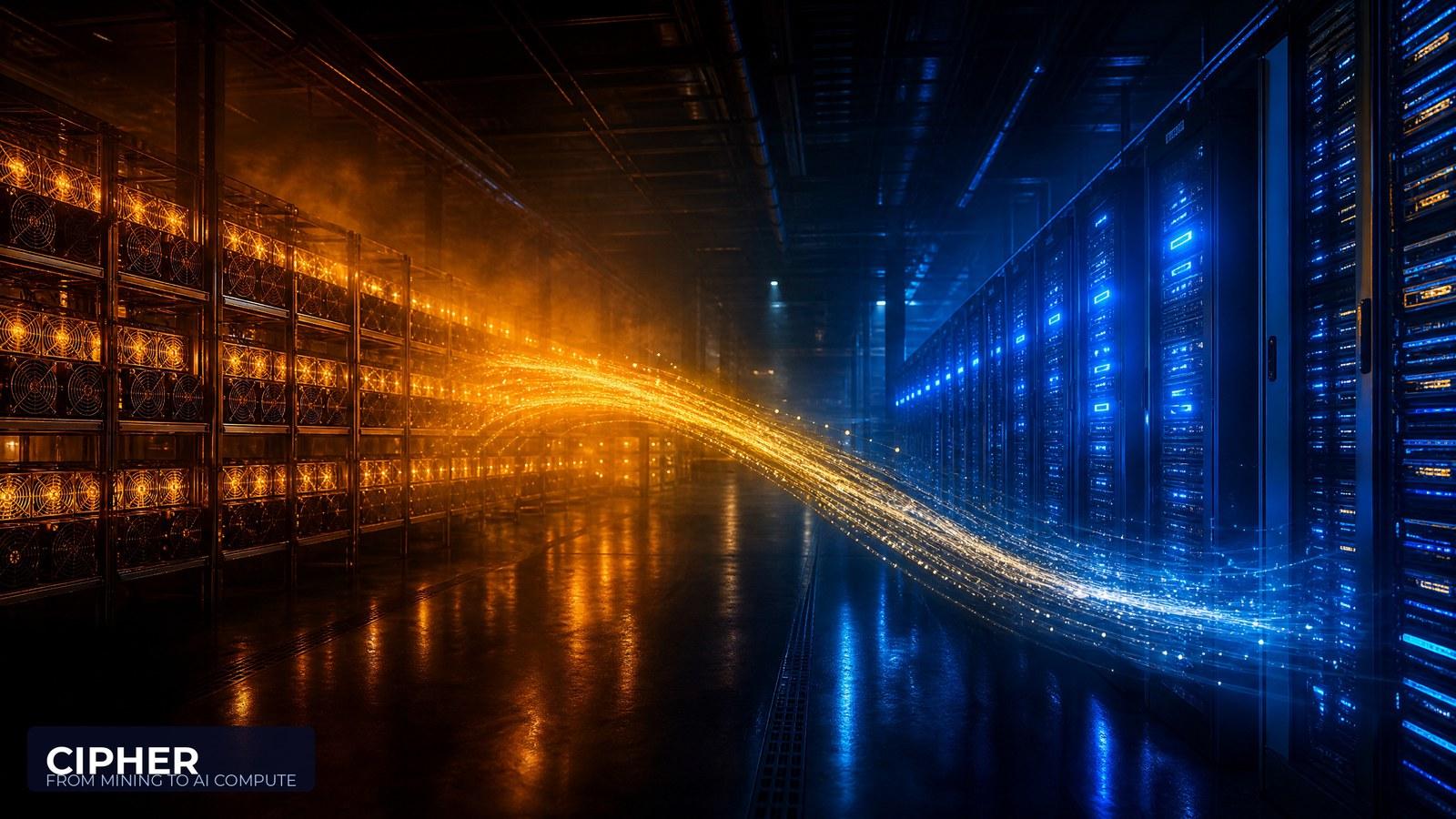
Cipher Digital, called Cipher Mining until February 20, 2026, reported third-quarter 2026 results on Monday, November 2, before the open. Revenue fell 62.8% to $26.7 million, after mining at Black Pearl was stopped, and the quarter recorded its first HPC lease revenue, $5.9 million. Net income, $31.6 million, comes from a non-cash gain on revaluing a liability to Google. The stock closed down 5.90% on the report day.
Errors or inaccuracies are possible. Spotted something that looks wrong? Write to me and I will correct it.
What was reported
| Q3 2026 | Q3 2025 | Change | |
|---|---|---|---|
| Revenue | 26.7 | 71.7 | -62.8% |
| ← Mining | 20.8 | 71.7 | -70.9% |
| ← HPC leasing | 5.9 | 0 | New |
| Compensation and benefits | 38.6 | 14.4 | 2.7x |
| General and administrative | 26.4 | 8.2 | 3.2x |
| Depreciation and amortization | 18.8 | 59.5 | -68.4% |
| Operating loss | (71.9) | (37.6) | 1.9x |
| Interest expense | (59.0) | (1.3) | 46x |
| Interest income | 32.7 | 0.5 | 72x |
| Change in fair value of warrant liability | 127.2 | 31.9 | 4.0x |
| Net income (loss) | 31.6 | (3.3) | Loss to income |
| Adjusted EBITDA | (10.0) | 40.8 | Income to loss |
Source: Cipher Digital's press release of November 2, 2026, filed with the SEC on Form 8-K as Exhibit 99.1, and the quarterly 10-Q. All amounts in $ millions. "Adjusted" is a non-GAAP measure. Changes are calculated from the release data.
Mining revenue, $20.8 million, came entirely from the Odessa site: mining at Black Pearl stopped in February, during its conversion to an HPC site. HPC revenue, $5.9 million, began in August with the first phase of the Black Pearl lease, of which $5.2 million is fixed rent recognized on a straight-line basis. Alongside falling mining revenue, payroll cost is rising: compensation and benefits of $38.6 million, of which $26.6 million is stock-based compensation, and general expenses of $26.4 million, mainly charitable contributions and legal fees related to strategic transactions.
The asterisk: profit that is not from the business
The quarter ended with net income of $31.6 million, but it was built on one item: a non-cash gain of $127.2 million on revaluing the warrant liability. Without it, the quarter would have been a net loss of about $95.6 million. Basic earnings per share are $0.08, and diluted is a loss of $0.22.
The source of the item: in September 2025 Google received warrants to buy 24.2 million shares at $0.01 per share, in return for backstopping part of Fluidstack's obligations under the Barber Lake lease. The warrants are booked as a liability at a fair value calculated from the share price, $504.9 million at September 30. A decline in the liability is booked as a gain, and during the quarter the share price fell 35.4%, from $24.50 to $15.83. The report does not state how much of the gain stems from the price decline.
The mechanism has another term that deserves attention. If, on the day before the exercise period begins, which is the start of the Fluidstack lease, the value of the warrant shares is below $435 million, Cipher is obligated to issue additional shares, pay cash, or a combination, in the amount of the difference. The final price will be set on the day before the period begins, and the share count may grow: on October 16 the conversion of the 2030 notes added about 2.0 million shares to the warrant base. The liability at September 30, $504.9 million, is above $435 million, and the report does not detail its composition.
Two more items below the line: interest expense of $59.0 million, net of capitalized interest, versus $1.3 million a year earlier, offset by interest income of $32.7 million on cash and restricted cash balances. Adjusted EBITDA, excluding the warrants, is a loss of $10.0 million versus income of $40.8 million a year earlier, and year to date a loss of $88.2 million versus income of $80.2 million.
The contracted portfolio
| Site | Capacity (MW) | Term | Contracted revenue over base term ($ billions) | Including extensions | Status |
|---|---|---|---|---|---|
| Barber Lake | 300 | 20 years | 9.1 | 9.1 | Data halls from Q4 2026 to Q1 2027 |
| Black Pearl | 300 | 15 years, plus three 5-year extensions | 5.5 | 14.1 | First phase began August 2026 |
| Stingray | 100 | 15 years, plus three 5-year extensions | 2.0 | 5.2 | Start in 2027 |
| Total | 700 | 17.3 years weighted average | 16.6 | 28.4 | Three sites |
Source: Cipher Digital's presentation for the business update of November 2, 2026. Expected average annual net operating income: $864 million, as defined by the company, an average monthly figure from August 2026 to July 2041 times 12. The Barber Lake figure includes additional lease revenue from costs that will be rented out, subject to final construction cost.
The material change in the quarter is Barber Lake. In September the company amended the lease with Fluidstack, which Google backs: the delivery schedule was set for data halls to be delivered between the fourth quarter of 2026 and the first of 2027, and the two five-year extension options were canceled. In parallel a binding agreement was signed with a leading AI lab, not named, for a further 10-year lease that begins after the Fluidstack lease term. The result: 20 years and $9.1 billion, an increase of about $5.2 billion. The presentation mentions a joint $10 million contribution by Cipher, Fluidstack and Anthropic to improve water infrastructure in the city of Colorado City, but does not state that Anthropic is the lab that signed the extension.
The price of the extension: instead of reimbursement for tenant changes, Cipher chose to invest additional capital. According to the 10-Q, the company will bear the first $359.3 million of costs above the original budget. Beyond that amount, the tenant will reimburse 50% of the overrun over 20 years as additional rent, at a contractual return. The presentation notes that expected annual net operating income at the site, $411 million, includes additional lease revenue from costs that will be rented out, and depends on final construction cost.
Balance sheet and financing
Property and equipment grew to $3.90 billion from $0.63 billion at the end of 2025, and long-term debt to $5.45 billion from $2.71 billion, against equity of $600.3 million and an accumulated deficit of $1.35 billion. Cash and equivalents: $656 million, plus $2.20 billion of restricted cash, $2.85 billion in all. In the first nine months of the year $2.52 billion was paid for property and equipment, and operations consumed $283.2 million.
In October $850 million of zero-coupon convertible notes due 2032 were issued, at an initial conversion price of about $15.31 per share; capped call transactions costing about $89.7 million lift the effective conversion price to $28.35. Part of the proceeds is meant to fund the additional equity investment at Barber Lake. In parallel, $165.9 million of the 2030 notes were exchanged for about 40.7 million shares, about 9.8% of shares outstanding at September 30, leaving about $6.6 million of them.
The development pipeline
The development pipeline totals about 5.9 GW: about 3.4 GW of grid capacity, subject to ERCOT's batch process, and up to 2.5 GW of on-site generation. In ERCOT's Batch Zero, Colchis received a conditional base load classification for 1 GW, and another 1.6 GW received a conditional classification under the PCLR designation, meaning load that may consume beyond its firm allocation but is subject to curtailment under ERCOT instructions. Final classifications are expected in December, after a data center audit. The company began developing lateral gas pipelines to enable up to 2.5 GW of on-site generation, targeting gas availability in 2027, and acquired Horizon, a 70 MW site that will be energized in 2029. Another 270 MW, at Reveille and Ulysses, is available in 2027, and the company is advancing discussions with tenants on them. There is no contract on those sites yet.
The two sides of the debate
The positive reading: all 700 MW in development is already leased, for 17.3 years on average, and contract value stands at $16.6 billion, after a $5.2 billion addition at Barber Lake. According to the company, several data halls at Black Pearl and Barber Lake are due online by year-end. Colchis, 1 GW, has a conditional ERCOT classification, and the added investment at Barber Lake was funded in part by zero-coupon notes.
The negative reading: revenue fell 63%, adjusted EBITDA is negative, and HPC rent, $5.9 million, is far below interest expense of $59.0 million. Long-term debt is nine times equity. Cipher bears the first cost overruns, up to $359.3 million, and the top-up mechanism for Google is exposed to the share price. The conversion of the 2030 notes added about 9.8% to the share count. And a pipeline of 5.9 GW is still without a contract, and part of it is subject to PCLR, which can be curtailed.
The stock
The report came before the open on November 2, so the trading reaction is the same day. The stock closed at $6.86, down 5.90% from $7.29, on volume of 55.4 million shares.
What will decide it
- Delivery of the data halls. Rent commencing at Barber Lake and Black Pearl by year-end, and the progression of revenue from $5.9 million.
- The Google mechanism at the start of the Fluidstack lease. The difference against $435 million is set by the share price on the eve of the period.
- Cost overruns at Barber Lake. Every dollar above $359.3 million is split 50/50 with the tenant.
- ERCOT's final classifications in December, and whether the 270 MW of 2027 and the 1 GW at Colchis turn into contracts.
- Cash flow. $283.2 million was consumed in nine months; lease revenue has to cover the interest.
Ilan Abramov, anyone on his behalf, or anyone on behalf of the authors may hold securities mentioned in this article, and holdings change from time to time.


