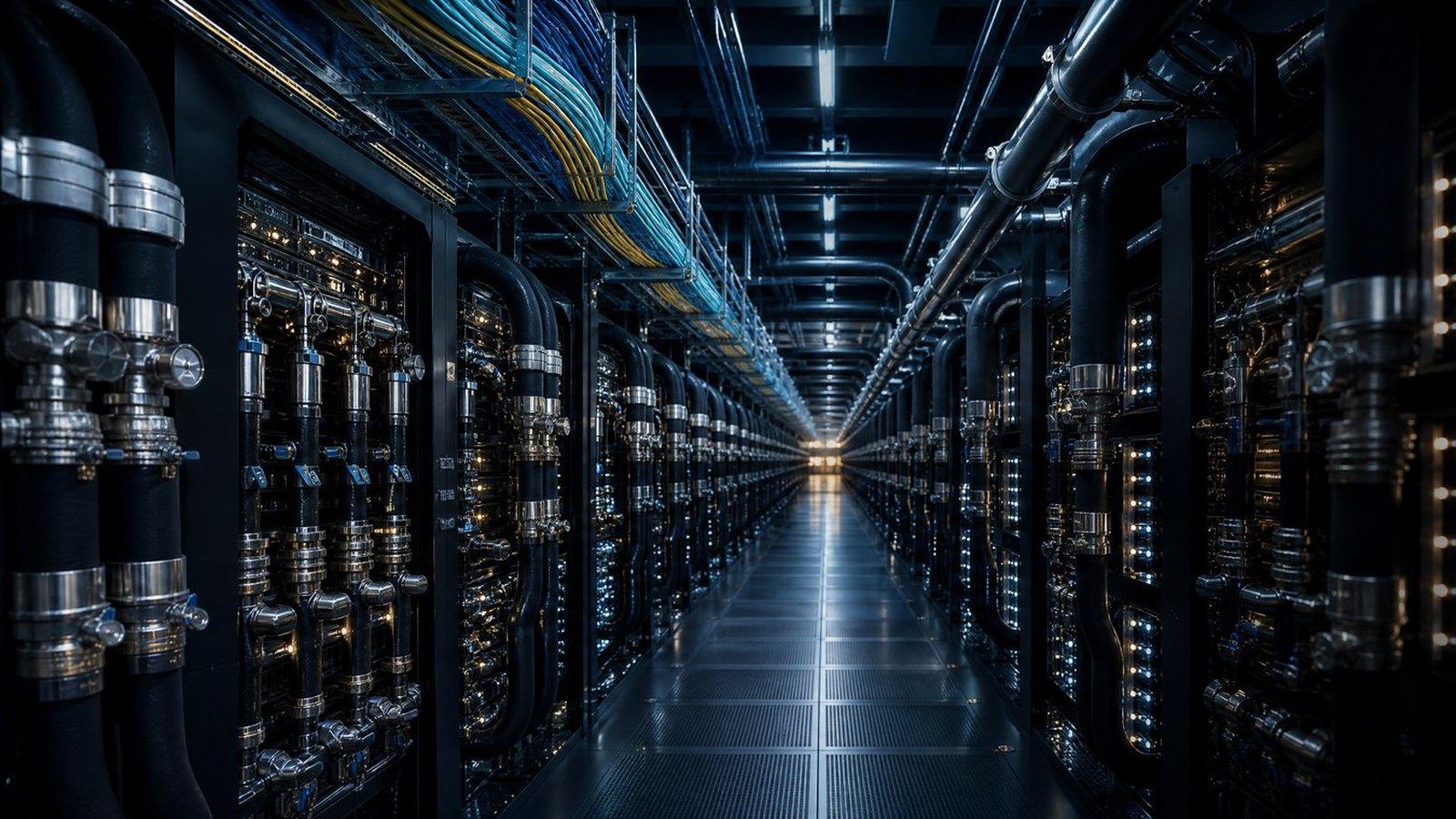
The four cloud giants invested about $202.9 billion in property and equipment in the third quarter - more than double the year-ago quarter at three of them. That money does not disappear: it lands in the suppliers' reports, and there the chain turns out to be anything but uniform. Chip and memory makers report gross and operating margins of 75% to 87%, while makers of power and cooling equipment report order backlogs that stretch years ahead.
Errors or inaccuracies are possible. Spotted something that looks wrong? Write to me and I will correct it.
The purse: how much the cloud giants invested
| Company | Q3 investment | Year-ago quarter | Change |
|---|---|---|---|
| Amazon | 77.259 | 35.095 | +120% |
| Alphabet | 51.355 | 23.953 | +114% |
| Microsoft | 39.367 | 19.394 | +103% |
| Meta | 34.91 | - | - |
| Total | about 202.9 |
In billions of dollars. Amazon, Alphabet and Microsoft: purchases of (additions to) property and equipment in the cash flow statement (for Microsoft, the first quarter of fiscal 2027). Meta: capital expenditures including principal payments on finance leases, by the company's definition; the comparative figure is not included here. Source: the companies' quarterly press releases.
The releases themselves carry two full-year outlooks. Amazon continues to expect about $220 billion of cash capital expenditures in 2026, and Meta narrowed its outlook to $135 to $145 billion, from $130 to $145 billion.
This spending is not only chips. It covers land, buildings, grid connections, cooling systems, networking equipment and servers. So the way to see where the money goes is to follow who sells to the giants - link by link.
We have already written about the cash flow side: at Alphabet, Amazon and Meta, the quarter's investment exceeded operating cash flow. This article is about the other side of the same money.
The first link: chips
On November 17 NVIDIA reported on the quarter ended October 25: revenue of $115.8 billion, up 103%, of which $107.6 billion from data center. Gross margin was 74.8%. For the next quarter, which includes an extra week, the company expects revenue of $130 billion, plus or minus 3%, and assumes no data center compute revenue from China.
The CFO commentary contains a breakdown that changes the picture. Revenue from the category NVIDIA calls Hyperscale rose 71% to $60.1 billion. Revenue from AI Clouds, Industrial and Enterprise rose 195%, to $47.5 billion. In other words, a growing share of demand comes from outside the big four - from neoclouds, model labs and enterprises.
NVIDIA's definition is not the same as the four companies in the table, so one number cannot be divided by the other. What can be said is that the orders of magnitude are similar: NVIDIA's total data center revenue in the quarter is more than half of what the four giants invested in the same quarter.
The second link: memory
Every AI accelerator needs fast memory next to it, and this is the part of the chain where the change in profitability has been most extreme.
On October 28 SK hynix reported third-quarter revenue of 104.6 trillion won, up 328% from the year-ago quarter, and operating profit of 83.3 trillion won - an 80% margin. According to the company, HBM4 shipments began in the quarter, and it expects HBM4 to overtake the previous generation, HBM3E, in both volume and revenue in the fourth quarter. It reported long-term agreements with 14 customers covering more than 50% of its 2027 and 2028 production capacity, and wrote that it expects demand to exceed supply through 2030.
Micron, which reports to the U.S. Securities and Exchange Commission, published on September 30 revenue of $54.23 billion for the quarter ended September 3, against $11.32 billion a year earlier. Gross margin rose from 44.7% to 86.8%. For the full fiscal year, revenue rose from $37.38 billion to $133.19 billion.
Micron's figure from a year ago matters as much as the current one. Memory is a product whose price is set by the balance of supply and demand, and the same company's margin moved by about 42 percentage points within a single year.
The third link: power
A data center needs electricity before it needs chips, and this link is measured in orders and backlog - not in 80% margins.
On October 28 GE Vernova reported orders of $29.3 billion, up 96% organically, and revenue of $12.6 billion, up 27%. Power segment orders rose 178% organically, to $21.8 billion. Gas turbine backlog together with slot reservation agreements rose from 116 to 122 gigawatts, and the company expects to reach at least 130 by year-end. Total backlog stood at $197 billion, and the company expects it to exceed $200 billion in the fourth quarter.
Two details balance the picture. A slot reservation agreement is not a firm order, and such agreements are part of the 122 gigawatts. And orders in the company's Electrification segment fell 9% organically, even though its equipment backlog rose to $42.2 billion.
The fourth link: cooling and the infrastructure inside the hall
Vertiv, which makes cooling and power management systems for data centers, reported on October 28 net sales of $4.31 billion, up 61% (55% organically), and organic orders up more than 100% from the year-ago quarter. The company raised its 2026 sales guidance to a range of $14.45 to $14.85 billion, $650 million higher at the midpoint. The release does not give the dollar value of orders or backlog.
The comparison between links makes the scale clear: Vertiv's quarterly revenue is about 4% of NVIDIA's.
Money flowing back
There is also movement in the opposite direction. NVIDIA's report lists $32 billion of commitments to neoclouds, which take effect only if they secure financing and the compute capacity is deployed. It also lists guarantees NVIDIA entered into in August for the buildout of a roughly 4.25-gigawatt campus in Ohio, which will exclusively host NVIDIA infrastructure under 20-year leases to OpenAI, with maximum exposure of $105 billion. According to NVIDIA, the guarantees take effect building by building, the first is expected in fiscal 2029, and no payments have been made under them to date.
NVIDIA explains in the report that neoclouds and frontier labs are growing faster than their balance sheets can support, and that it has entered into arrangements that help select customers secure land, power and shell capacity.
Two readings of the same numbers
The first reading: demand is broadening and lengthening. NVIDIA's revenue from customers other than the cloud giants rose 195%. SK hynix has signed agreements covering most of its capacity two years out, and GE Vernova is converting slot reservations into orders. On this reading, the chain rests on long contracts and a widening customer base.
The second reading: the money is concentrated, and the financing is getting more complex. Three of the four giants invested more than their operating cash flow in the quarter. NVIDIA is providing guarantees and commitments to customers whose balance sheets, in its own words, do not keep pace with their growth. Memory margins rose by more than 40 percentage points in a year, which is also what makes them sensitive to any change in the balance of supply and demand. And part of the power backlog is not firm.
Both readings rest on the same reports. The difference between them is the question of how long the cloud giants' investment keeps growing at this pace.
What will decide
- 2027 investment outlooks. The cloud giants' fourth-quarter reports are expected in late January and early February, and that is where next year's numbers will appear.
- NVIDIA's outlook. $130 billion for the fourth quarter, with no data center compute revenue from China.
- The move to HBM4. SK hynix expects the new generation to overtake the previous one as early as the fourth quarter.
- Conversion of slot reservations into orders. At GE Vernova, the 122 gigawatts include agreements that are not yet orders.
Ilan Abramov, the author, or anyone on his behalf may hold securities mentioned in this article, and holdings change from time to time.


